

Top female divorce lawyer Bangalore
Choosing to end a marriage is one of the most emotionally challenging and legally complex decisions a person can make. When couples face matrimonial disputes, the local legal framework, court protocols, and procedural timelines can quickly overwhelm them. Securing skilled, empathetic legal representation becomes essential during this transition.
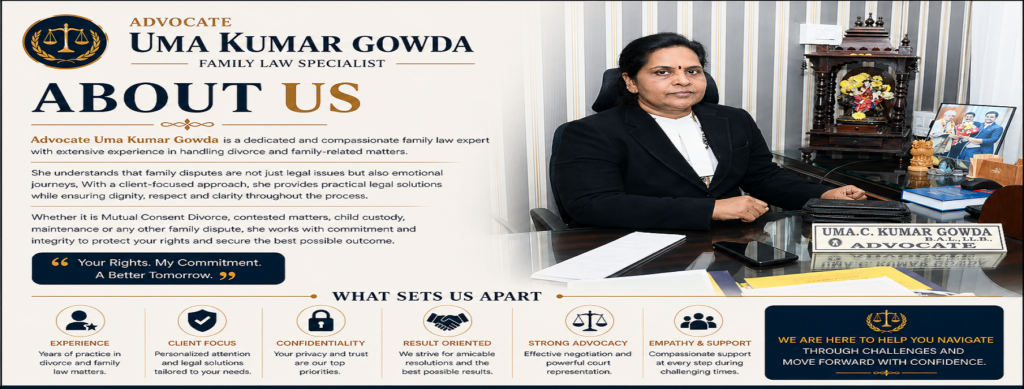
For individuals seeking a compassionate yet firm approach, consulting the top female divorce lawyer in Bangalore provides the necessary clarity and legal protection. This comprehensive guide outlines the critical pathways of Indian family law, explains essential strategies for asset and custody protection, and highlights how divorcelawyerumakumargowda secures optimal outcomes for clients navigating these difficult transitions.
Understanding the Legal Landscape of Divorce in India
Indian family law does not follow a singular, uniform rulebook for matrimonial disputes. Instead, the legal rules governing a divorce depend primarily on the religion under which the couple solemnized their marriage.
The Governing Marriage Acts
The Hindu Marriage Act, 1955 (HMA): This Act governs Hindus, Sikhs, Buddhists, and Jains. It provides provisions for both mutual consent divorce (Section 13B) and contested divorce (Section 13).
The Special Marriage Act, 1954 (SMA): This secular law applies to inter-faith couples or individuals who registered their civil marriage under this specific framework.
The Indian Divorce Act, 1869: This law governs the dissolution of marriages within the Christian community.
The Dissolution of Muslim Marriages Act, 1939: This legislation outlines the specific grounds and legal rights available to women seeking a divorce under Islamic jurisprudence.
Navigating these distinct religious and civil statutes requires a deep, comprehensive understanding of personal laws. Experienced family attorneys analyze the specific details of your marriage registration to determine the most strategically advantageous legal framework for your case.
Mutual Consent vs. Contested Divorce: Choosing Your Path
When a marriage breaks down irretrievably, a couple must choose between two main legal pathways: mutual consent or a contested battle. The path selected completely changes the duration, cost, and emotional stress of the proceedings.
+-----------------------------------------------------------------+
|                       DIVORCE PATHWAYS                          |
+-----------------------------------------------------------------+
                                 |
        +------------------------+------------------------+
        |                                                 |
        v                                                 v
 [ MUTUAL CONSENT ]                               [ CONTESTED ]
  - Both parties agree                             - One party files
  - Joint petition filed                           - Proves specific grounds
  - Faster resolution                              - Lengthy litigation
  - Lower emotional stress                         - Higher financial cost
Mutual Consent Divorce: The Amicable Route
A mutual consent divorce represents the fastest, cleanest, and most dignified method to dissolve a marriage. Under Section 13B of the Hindu Marriage Act, both spouses jointly state that they can no longer live together and have mutually decided to separate.
Essential Requirements for Mutual Consent:
Separation Period: The couple must live separately for at least one full year before filing the petition.
Settlement of Terms: Both parties must reach a complete agreement regarding alimony, child custody, and the division of shared assets before entering the courtroom.
The Two Motions: The court mandates a statutory six-month waiting period (the First Motion) to allow for potential reconciliation. If no resolution occurs, the parties move the Second Motion within 18 months of the initial filing to finalize the divorce decree.
Contested Divorce: Fighting for Your Rights
When one spouse refuses to grant a divorce or when the parties cannot agree on financial or parental terms, a contested divorce becomes necessary. This process requires the filing spouse to prove specific statutory grounds before the family court judge.
Common Grounds for Contested Divorce:
Cruelty: This includes physical violence or severe mental torture that makes cohabitation impossible or unsafe.
Desertion: One spouse must abandon the other without a reasonable cause for a continuous period of at least two years.
Adultery: Voluntary sexual intercourse outside the marriage remains a strong ground for seeking a judicial dissolution.
Conversion: One spouse leaves Hinduism or the original faith to join another religion.
Mental Disorder: Unsoundness of mind or mental illness of such a nature that the spouse cannot reasonably expect to live with them.
Child Custody and Guardianship Protocols
No aspect of family law demands more sensitivity and strategic care than child custody. Indian family courts operate under a singular, uncompromising principle: the paramount welfare of the minor child. The court heavily de-emphasizes the automatic legal rights of parents in favor of protecting the child’s emotional, educational, and physical well-being.
Types of Custody Arrangements Available
| Custody Type | Legal Meaning and Operational Reality |
| Physical Custody | The child resides primarily with one parent, who manages day-to-day living, school routines, and immediate care. The other parent receives structured visitation rights. |
| Joint Custody | Both parents actively participate in major life decisions regarding education, healthcare, and religious upbringing, even if the child resides primarily with one parent. |
| Legal Custody | This grants a parent the absolute right to make long-term foundational decisions for the child’s future, without necessarily sharing physical custody. |
Alimony, Maintenance, and Asset Protection Strategies
Financial security forms the foundation of life after divorce. Spouses must understand their rights regarding temporary support, permanent alimony, and the equitable division of shared matrimonial assets.
Interim vs. Permanent Maintenance
Interim Maintenance (Section 24 of the HMA): This addresses the financial needs of a dependent spouse during the pendency of the divorce litigation. It covers reasonable living expenses and the actual cost of court proceedings.
Permanent Alimony (Section 25 of the HMA): This represents the final lump-sum payment or recurring monthly financial allowance ordered by the judge at the time of passing the final decree.
       [ FINANCIAL PROTECTION CHECKLIST ]
  ✔ Locate and copy all joint bank statements
  ✔ Secure property title deeds and registration papers
  ✔ Compile accurate income tax returns (ITRs) for both parties
  ✔ Document corporate shareholdings and mutual fund portfolios
  ✔ Preserve safe-deposit locker inventories and gold bills
Navigating Allied Family Law Matters: DV and Section 498A
Matrimonial breakdowns rarely occur in complete isolation. Complex divorces frequently overlap with criminal and quasi-criminal legal proceedings designed to protect individuals from domestic abuse and harassment.
The Protection of Women from Domestic Violence Act, 2005 (DV Act)
The DV Act provides immediate, comprehensive relief to women facing physical, emotional, verbal, or economic abuse within a shared household. A skilled lawyer utilizes this Act to secure crucial, immediate protections:
Residence Orders: Stopping the husband or in-laws from throwing the woman out of the matrimonial home.
Monetary Relief: Securing immediate emergency funds for medical expenses and monthly maintenance.
Protection Orders: Legally barring the abusive spouse from contacting the victim at her workplace or residence.
Section 498A of the Indian Penal Code (IPC)
This section deals with matrimonial cruelty and dowry harassment inflicted by the husband or his paternal relatives. Because this law carries serious criminal consequences, it requires careful legal management.
Whether you need to invoke these protections to safeguard your safety or require robust defense strategies against false or exaggerated allegations, a seasoned litigator ensures the law serves its true purpose without being misused as a tool of coercion.
Why Choose divorcelawyerumakumargowda in Bangalore?
When handling complex matrimonial disputes, selecting the right legal counsel directly impacts your piece of mind and the long-term outcome of your case. divorcelawyerumakumargowda stands out as a leading destination for comprehensive family law solutions in Bangalore for several reasons:
30 Years of Dedicated Legal Expertise: Advocate Uma Kumar Gowda brings three decades of independent courtroom experience handling complex family, civil, and criminal matters across the Family Courts and the High Court of Karnataka.
A Balanced, Client-Centered Approach: The firm prioritizes strategic, transparent legal counseling. We focus on achieving amicable, timely settlements via mediation while maintaining the readiness to litigate aggressively when a client’s rights are threatened.
Absolute Confidentiality and Ethics: Matrimonial matters require the highest levels of privacy and trust. The firm handles every file with strict discretion, sensitivity, and personalized attention.
Multilingual Capabilities: Communication barriers disappear in critical legal discussions. Advocate Uma Kumar Gowda consults fluently across English, Kannada, Hindi, Tamil, and Telugu, ensuring clients communicate comfortably during stress-filled moments.
Conclusion
A divorce marks the conclusion of a chapter, but it also provides the foundation for a peaceful, empowered new beginning. Protecting your emotional well-being, securing financial stability, and shielding your children from unnecessary conflict depend on making informed, objective legal choices from the very start.
Partnering with an experienced, compassionate legal advocate turns a chaotic process into a manageable, strategic transition. If you face a matrimonial crisis, need advice on asset division, or want to explore an amicable mutual separation, protect your interests by consulting the top female divorce lawyer in Bangalore. Reach out to divorcelawyerumakumargowda today to schedule a confidential consultation and take your first step toward an organized future.